

Partnerships as a Catalyst for the Future Supply Chain
As supply chains become more vulnerable and the demands for sustainability, transparency and speed increase, another tool or dashboard is no longer enough. Competitive advantage arises when companies commit to real partnerships; sharing goals, data and responsibility. In the ecosystem around Meridion, Infor and PipeChain, we see how collaboration and shared insight create both resilience and practical results.
Partnerships as a USP – from contracts to shared responsibility
Partnerships have long been a buzzword in PowerPoints. Now they are becoming a way of working. The difference lies in mindset, shared goals and starting with the concrete. Agneta Lund, CEO of PipeChain Networks, describes how outsourcing once was viewed as the ultimate partnership, but often ended up as a traditional buyer—supplier relationship: “The idea of outsourcing is solid — collaboration with clear responsibilities and interfaces. But in practice it often became just a regular buyer–supplier setup. No real partnership, no real win–win.”
Today, expectations are different. Partnerships mean acting as one team, something Agneta believes is driven by the fast pace of technological development: “Now there is much more focus on working as a team through partnerships and collaboration. I believe that’s because technology is advancing so quickly, and what’s needed going forward is the ‘human part, where seamless, simple collaboration makes the real difference.”
Åsa Jansson, CEO of Meridion, is clear that partnerships are core to their business: “Partnerships are absolutely crucial for us — without them, Meridion wouldn’t exist.” She explains how the ecosystem works in practice: sometimes Meridion leads the ERP project for the customer, sometimes Infor does. That requires flexibility and a shared view on value: “We work in an ecosystem where roles shift; sometimes we lead the overall customer engagement, and sometimes we contribute with deep expertise alongside partners like Infor and PipeChain. What matters is focusing on customer value — creating real, measurable results in their supply chain.”
Håkan Strömbäck, Industry & Solution Strategy Director at Infor, sees the same shift: “I see a growing emphasis on strategic partnerships. Previously, it was more of a contractual relationship.” For Infor, this means constantly weighing partnership, acquisition or building capabilities internally: “It’s a continuous process; deciding when to rely on a partner, when to acquire something, and when we need to build the capability ourselves.”
Value emerges when we decide together what matters
Data driven decision making sounds live a given point to agree on. The challenge is agreeing on which data matters, when it’s needed and how insights should guide behaviour. Åsa sees data quality as one of the biggest issues: “How many versions of the same concept exist? We need to use the same language to ensure we’re discussing and analysing the same thing in order to create real value.”
Håkan adds another dimension: it’s not the amount of data that determines whether technology — like AI — works, but the density of the data: “The problem is rarely volume. It’s density. You can have massive amounts of data, but if the relevant data points aren’t there, AI results will be weak. For example, an AI driven forecast works fine for products with good history, but for a new or niche product, there may be too few observations. Then the recommendation simply isn’t reliable.”
Meanwhile, automation is increasing, meaning that validation is often left to algorithms: “We’re automating more and more, and we no longer perform the validation ourselves; we expect algorithms to do it.”
For PipeChain, data is the backbone of their service. Agneta explains: “Our entire service is built on exchanging data between business partners. It’s critical business data that affects daily operations — often without people even noticing.” With that comes responsibility: “We depend on correct data and proper handling on all sides. That’s why dialogue with partners is essential.”
A supply chain in transition: visibility, resilience and speed
The supply chain is no longer a chain. It’s a network that must react quickly to global shifts — geopolitics, tariffs, sustainability requirements and cyber risks. Håkan sees clear trends: “Supply chain patterns are shaped by geopolitics, increasing or decreasing self sufficiency, and multisourcing. Staying fully up to date is impossible, but the most agile companies can navigate the challenges.”
In Europe, the focus on regionalisation — increased self sufficiency — is intensifying, reshaping the entire system. At the same time, resilience is becoming non negotiable. Agneta stresses this: “Resilience remains a must for supply chains — the ability to withstand external influences such as legislation, tariffs and cyberattacks.”
This makes visibility and coordination business critical: knowing what is happening (not just what should be happening), aligning planning, procurement, production and distribution, and making timely decisions. Åsa emphasises: “Customers have narrow margins, and optimising processes and minimising inventory is becoming more important.”
Technology is simultaneously advancing fast. Håkan describes how AI agents are already entering everyday operations: “We have a supply chain agent, a warehouse agent and multi agents that orchestrate everything. Agents will be even more central in 2026 — it’ll be exciting.” But he also sees a risk: “There’s a danger that technology outpaces organisations’ ability to absorb it, widening the gap between what we deliver and what they can adopt.”
Åsa agrees that AI is here to stay, but tones down the hype: “AI will become a natural part of the digital ecosystem. Right now there’s a hype driven push where many organisations launch generic chatbots as a ‘quick win’. It’s a low threshold application and a way to signal AI maturity, but it risks locking companies into superficial use cases. Real value comes when AI is tied to core processes, automated decision flows, scalable platforms and long term transformation.”
Agneta echoes this: “For us, it’s about using AI where it truly matters: predicting disruptions, optimising flows and freeing up people to focus on value. By 2026, AI will be a natural part of supply chain operations — not a separate project, but integrated into daily work.”
The future is shared
Technology is moving quickly. But without collaboration, it becomes just another cost. When companies build real partnerships — sharing goals, data and responsibility — both quality and speed increase. The ecosystem around Meridion, Infor and PipeChain shows that progress isn’t about adding more tools, but about how people and solutions work together in daily operations.
Insights

If you are interested in learning more about how to create a powerful connected supply chain, here are our latest insights.
Tech papers
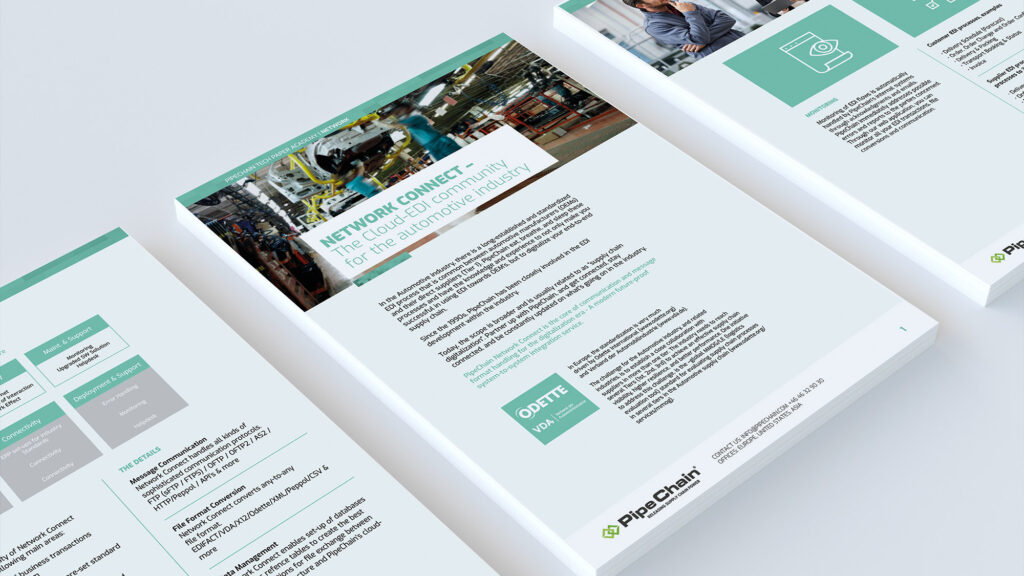
To help you get a deeper and better understanding of our solutions and your supply chain, we have developed a number of detailed tech papers on different subjects.


-
Necessary
These cookies are not optional. They are needed for the website to function. -
Statistics
In order for us to improve the website's functionality and structure, based on how the website is used. -
Experience
In order for our website to perform as well as possible during your visit. If you refuse these cookies, some functionality will disappear from the website. -
Marketing
By sharing your interests and behavior as you visit our site, you increase the chance of seeing personalized content and offers.