

Automating customer orders with PDF interpretation
In many companies, order processing still relies on manual steps. Customer orders are sent as PDF attachments via email, opened, interpreted, and manually entered into the business system. This way of working has long been sufficient, but as volumes increase, demands for accuracy grow, and faster workflows are required, the limitations are becoming increasingly clear.
To address this need, PipeChain has developed a solution that, with the help of AI, can interpret and automate PDF-based order flows without requiring any changes from the customer.
From bottleneck to flow
The PDF format is fundamentally designed for humans, not systems. Information is presented visually rather than in a structured way, which means each document must be interpreted in its specific context. Even when the content is the same, layout, structure, and terminology may vary.
As a result, the information cannot be used directly in business systems, manual steps are required to proceed, and the risk of errors increases. This is often where the flow slows down, even though the data already exists. A common challenge in digitizing order flows is the dependency on the customer’s technical maturity. Despite the need for efficiency, not all customers have the capability or incentive to implement EDI or other integration solutions.
So how can automation be driven without creating friction in the business?
Instead of changing customer behavior, existing workflows are used as they are. Orders are still sent via email, but are automatically interpreted with the help of AI, structured, and transferred into the business system without manual handling. This is a way to enable automation without making it more complicated to be a customer. Lead times are reduced, quality improves, and the organization gains the ability to work more proactively. The organization can instead focus on relationships, service, and more value-creating work.
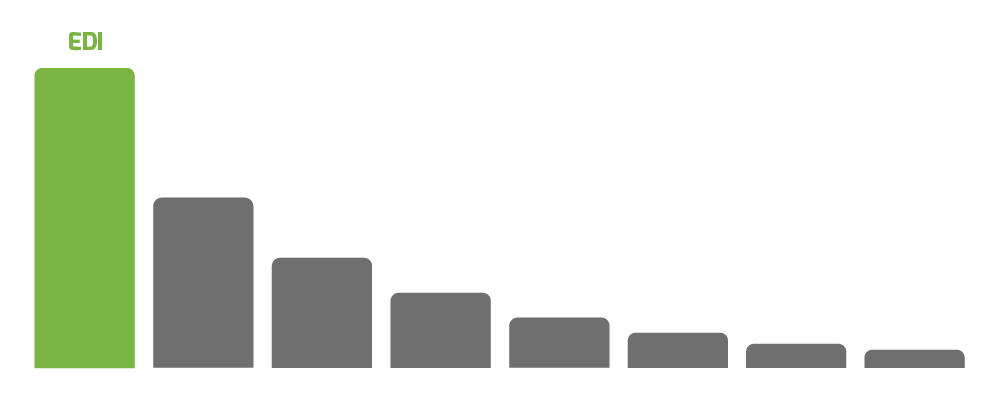
Traditional EDI works great for your largest partners, but often leaves the majority of your customers out. This is where the administrative burden grows. Our PDF solution is designed to capture those customers who are not ready for full integration, but who you still want to manage digitally, by automating the entire “long tail”.
What does it actually mean to interpret a PDF?
It is not just about reading text. The challenge lies in making the information usable. Understanding the content, handling variations in how documents are structured, and transforming it into data that can be used directly in the business. With AI, this interpretation can be done automatically, even when documents differ in structure and layout. Once this works, the manual step in between disappears. Incoming PDF documents can then automatically become completed orders in the business system, without anyone needing to intervene.
That is where the real value is created.
Want to know more? Contact us at info@pipechain.com
Insights

If you are interested in learning more about how to create a powerful connected supply chain, here are our latest insights.
Tech papers
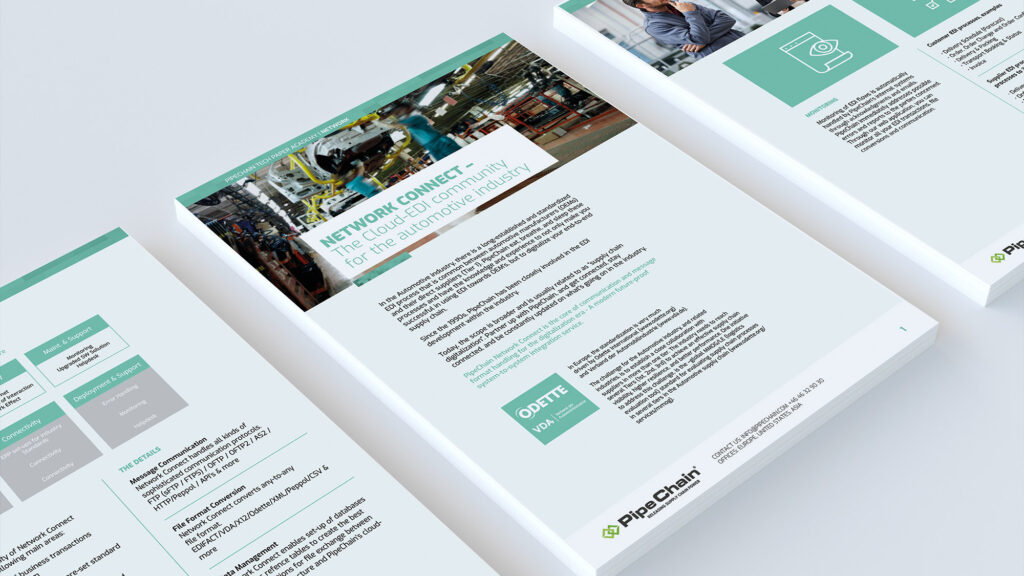
To help you get a deeper and better understanding of our solutions and your supply chain, we have developed a number of detailed tech papers on different subjects.



-
Necessary
These cookies are not optional. They are needed for the website to function. -
Statistics
In order for us to improve the website's functionality and structure, based on how the website is used. -
Experience
In order for our website to perform as well as possible during your visit. If you refuse these cookies, some functionality will disappear from the website. -
Marketing
By sharing your interests and behavior as you visit our site, you increase the chance of seeing personalized content and offers.